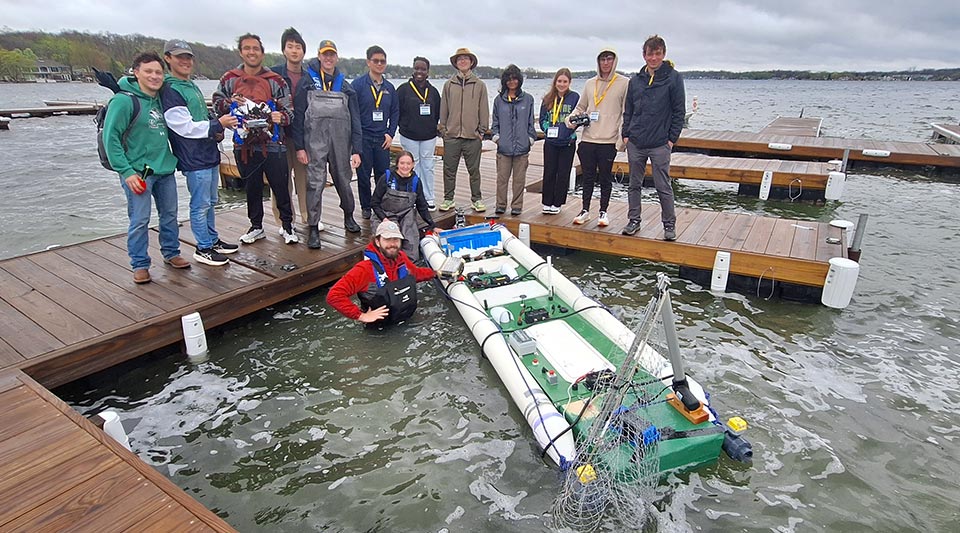
The University of Notre Dame’s Artificial Intelligence Maritime Maneuver (AIMM) team secured a second-place finish overall at the 2026 Indiana Collegiate Challenge (ICC). The team shared first place with Indiana University, Bloomington on the course challenge, which necessitated navigating a complex series of obstacles, collecting data and returning to base.
Since the inaugural competition in 2024, Trine University, in partnership with the Naval Surface Warfare Center Crane Division (NSWC Crane), has hosted the event. The competition challenges Indiana engineering students to design and deploy autonomous Low Profile Vessels (LPVs) capable of navigating complex maritime missions without human intervention.
The competition was held at Pokagon State Park in Angola, Indiana, April 17-18, drawing teams from Indiana University, Bloomington; Purdue University campuses in Fort Wayne and Indianapolis; Notre Dame; and host institution Trine University. After two years of competing with a fixed-hull design, the team, advised by Enes Aydin, Notre Dame Engineering Learning Center Manager, made the strategic decision to retire their championship-winning vessel in favor of a brand-new, modular design.


The new vessel features removable bow and stern sections, allowing for rapid hardware upgrades and easier maintenance. Perhaps the most innovative mechanical addition was a dynamic external ballast system. Moving away from bulky weights that need to be carried everywhere, the team engineered a PVC ballast structure capable of holding up to 275 pounds of water, allowing the boat to sit lower in the water for stealth maneuvers—a key requirement of the “Lidar Evasion” challenge—while remaining light enough for easy transport.
The technical innovation wasn‘t limited to the hardware. The 2025-2026 team significantly advanced the vessel‘s “brains.” Using the YOLOv8 vision, an AI vision framework, the boat was able to identify and categorize buoys and obstacles in real-time.
To ensure the software was ready for the unpredictable environment of Pokagon Park’s Lake James, the team utilized a “Simulation-First” development cycle. By recreating the entire competition course in the Gazebo simulation environment with ROS integration, the students were able to log hundreds of virtual test hours before the boat ever touched the water.
“The encouragement from mentors like James Alleman was instrumental in our decision to pursue the new hull design,” said Aydin. “We’ve learned invaluable lessons from this prototype. We aren‘t just celebrating a win; we are building a foundation that will make us even stronger next year.”

Members of the Notre Dame AIMM team included: seniors: computer science and engineering majors Manny Hammer, Ryan Paillet and Allen Uy; juniors: Regan Ball, an aerospace and mechanical engineering major; sophomores: electrical engineering majors Jakob Kotz, Gloria Mahoro and Salvador Wienecke; freshmen: aerospace and mechanical engineering major Batyrkhan Alimzhanov; electrical engineering major Heather Schwartz; and computer science major Anika Joseph.
—Notre Dame College of Engineering